The shock before the rescue
The case for intervention began with a real economic shock.
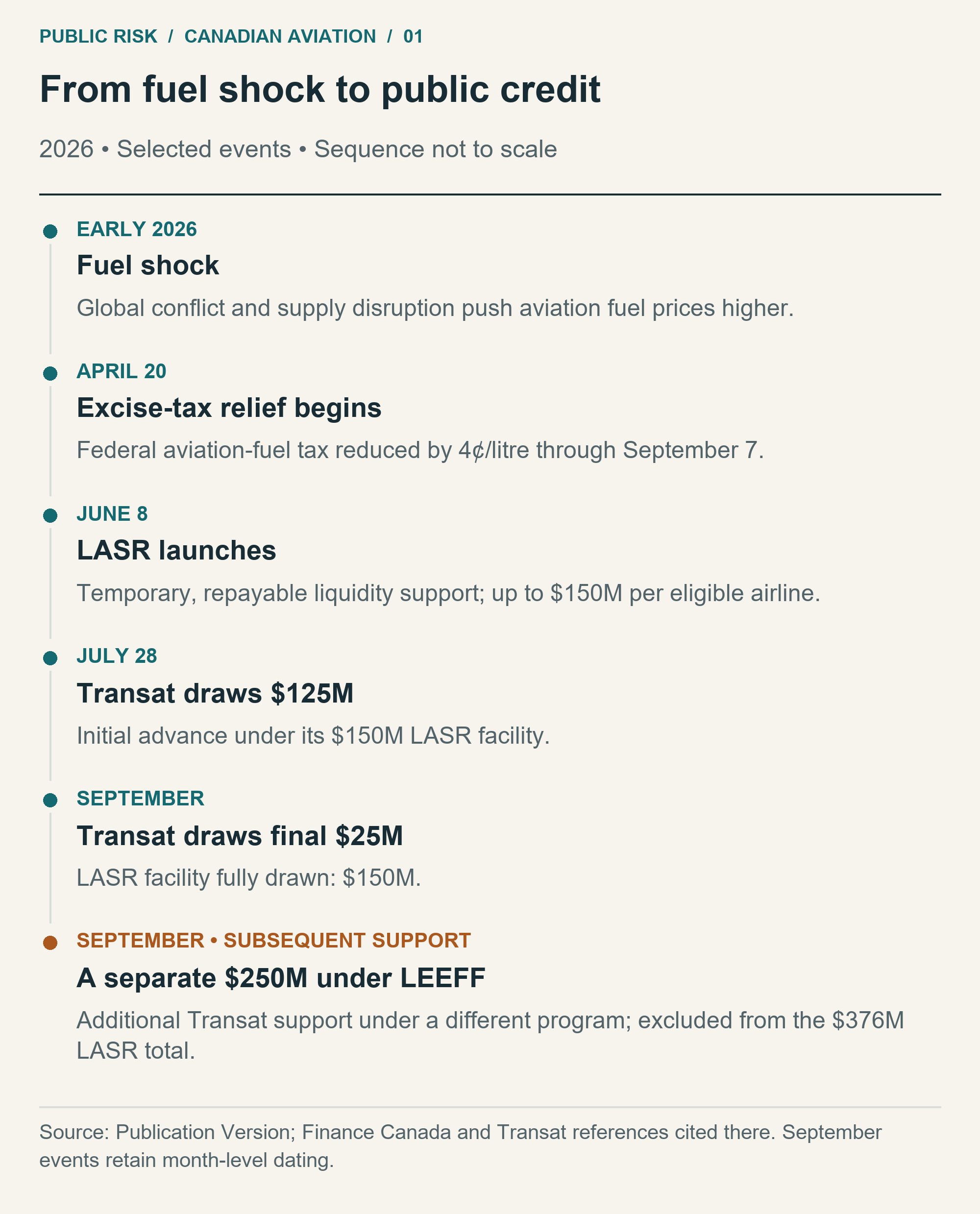
In early 2026, global conflict and supply disruption drove a sudden increase in aviation fuel prices. Airlines faced an unusually difficult timing problem: many seats had already been sold at prices set before the shock, while the fuel required to operate those flights had to be purchased afterward at much higher prices.
Fuel was already one of the industry’s largest expenses. Statistics Canada reported that turbo fuel represented roughly 22.6% of operating expenses for major Canadian airlines in the fourth quarter of 2025. When fuel prices jumped, carriers could impose surcharges on new bookings, cut capacity, adjust networks or hedge part of their exposure. None of those tools could fully reprice tickets already sold.
Transat provides the clearest public example. The company estimated that higher fuel costs reduced adjusted EBITDA by approximately $70 million in March and April alone, after hedging. Together with the suspension of Cuba operations and lower compensation related to Pratt & Whitney engine issues, the deterioration helped push second-quarter adjusted EBITDA from a $98.4 million profit a year earlier to a $20.7 million loss.
The shock was not confined to companies that ultimately borrowed from Ottawa. WestJet also reduced planned flying as it responded to elevated fuel costs. The industry-wide nature of the disruption matters: it weakens the simplest version of the bailout argument, in which financial pressure itself is treated as proof of prior mismanagement.
Ottawa first temporarily removed the federal aviation-fuel excise tax, reducing the burden by four cents per litre from April 20 to September 7. Then, on June 8, it launched the Liquidity for Airline Sector Resilience facility, or LASR.
The government described LASR as temporary, targeted and repayable. Eligible Canadian passenger airlines could receive up to $150 million, with facility size linked to the increase in aviation-fuel costs relative to the same period in 2025. The program was explicitly designed for temporary liquidity pressure.
That establishes the first half of the case.
The shock was real.
The policy conclusion does not automatically follow.
A temporary liquidity problem and a structural solvency problem can look similar in the middle of a crisis. The important question is whether LASR bridged otherwise viable airlines through an extraordinary disruption — or whether the disruption gave government a reason to assume risks private capital was unwilling to take.
Follow the money
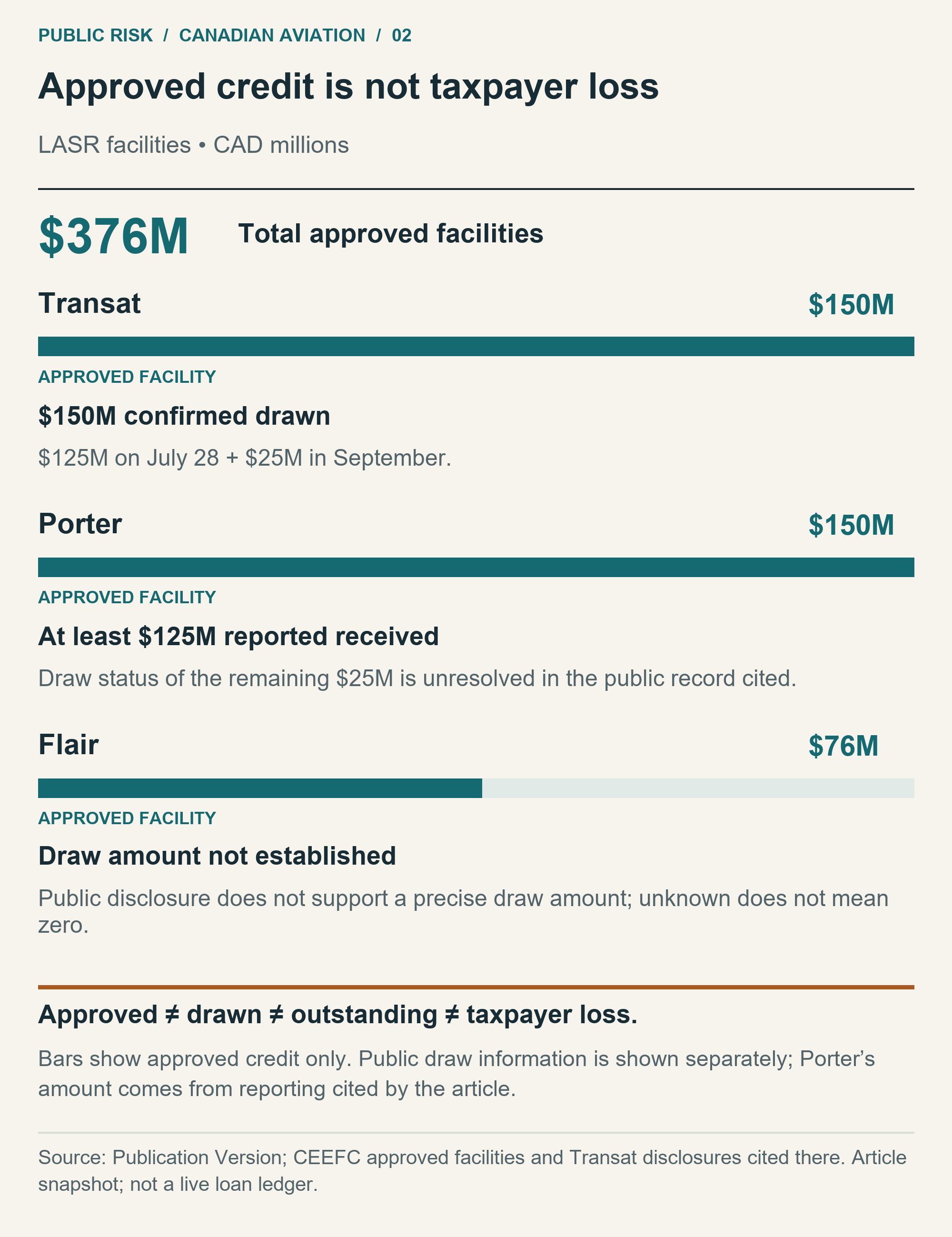
As of the current public record, CEEFC lists three LASR facilities: $150 million for Air Transat, $150 million for Porter Airlines and $76 million for Flair Airlines.
Total approved facilities: $376 million.
That number requires care.
Approved is not the same as drawn. Drawn is not the same as outstanding. And none of those is the same as taxpayer loss.
Transat’s position is clear. Its $150 million facility initially advanced $125 million on July 28 at a stated annual interest rate of 3.91%. The remaining $25 million was drawn in September, bringing the facility to its full $150 million.
Porter’s approved facility is $150 million. Contemporary reporting described at least $125 million as received, while the public record does not cleanly reconcile the remaining $25 million. Public disclosure for Flair’s $76 million facility is not sufficient to reconstruct an equally precise draw history.
The distinction matters because LASR is debt, not a grant.
Its pricing also goes beyond the headline coupon. The program sets interest at the 10-year Government of Canada bond yield at launch plus 50 basis points. Borrowers also face a 5% fee on aggregate principal advanced, another 5% if the facility remains outstanding more than 12 months after the initial advance, and a 0.25% transaction fee at closing.
For illustration, a fully drawn $150 million facility held for four years at 3.91% would generate approximately $23.46 million of simple interest. Add the two 5% fees and the 0.25% transaction fee, and total financing costs approach $38.84 million. Expressed as a simplified annualized cost over four years, that is roughly 6.3%.
That is not a contractual effective interest rate and it is not proof that LASR was priced at market value. It is a way of showing why calling the principal a subsidy is economically wrong.
The more relevant question is whether the government was adequately compensated for the credit risk it assumed.
An internal federal Question Period note described LASR rates as above the government’s borrowing cost but favourable relative to market rates for affected companies. That is revealing but incomplete. Without knowing what comparable private financing would have cost each borrower — or whether it was available at all — the subsidy embedded in the credit terms cannot be measured precisely.
LASR also imposed restrictions on dividends, share repurchases, executive compensation and certain corporate transactions, while requiring commitments related to Canadian operations, employment and suppliers. These are not the terms of an unconditional transfer.
But “commercial terms” do not make public credit economically neutral. A government can charge interest and still accept risks that private lenders would demand much more to bear.
That is why the identity of the borrowers matters.
Three airlines, three different risks
The cleanest way to evaluate the borrowers is to freeze the analysis immediately before the fuel shock. Judging them only after fuel prices exploded would be circular: the deterioration that justified emergency liquidity would become evidence that the companies were never viable.
The public record produces three different pictures.
Transat: recovery on a fragile balance sheet
Transat entered 2026 with genuine operating momentum. Fiscal 2025 revenue reached approximately $3.40 billion, adjusted EBITDA rose to a record $271 million, and operating activities generated $157 million in cash.
But free cash flow remained negative, and the balance sheet was still heavily leveraged. More importantly, the company had already required a major restructuring of government-backed LEEFF debt in 2025. Transat and CEEFC said that restructuring reduced outstanding CEEFC debt from $772 million to $334 million as of March 31, 2025, while extending and restructuring the remaining obligations.
That makes the 2026 fuel shock material but not sufficient to explain Transat’s financial vulnerability.
The subsequent sequence reinforces the distinction. Transat drew the entire $150 million LASR facility. In September, CEEFC then provided another $250 million under LEEFF.
Transat is therefore the hybrid case: a genuine external shock landed on top of a capital structure that was already fragile.
Fuel did not invent the balance-sheet problem. It accelerated it.
Porter: growth risk is not the same as distress
Porter presents the opposite evidentiary problem. It is privately held and does not publish the financial statements needed to independently observe leverage, cash burn or profitability.
What is visible is extraordinary expansion.
Porter received its first Embraer E195-E2 in December 2022 and reached 50 aircraft by December 2025. It has 75 firm E195-E2 orders and purchase rights for another 25. The aircraft supported rapid expansion across Canada, the United States, Mexico, the Caribbean and Central America.
External financing also continued to support that expansion through aircraft and engine sale-and-leaseback transactions. That does not prove Porter could have raised $150 million of unsecured emergency liquidity on LASR-like terms. Asset-backed aviation finance is not the same product.
But it does establish something narrower: capital had not universally abandoned Porter before the shock.
CEO Michael Deluce also acknowledged the limitation directly when asked about profitability in 2026, describing Porter as still in an “investment stage.” Rapid growth can consume cash even when a business is moving toward sustainable economics.
On the public evidence, Porter is therefore the strongest candidate for the classic bridge-financing interpretation: a rapidly expanding challenger exposed to the cash demands of growth when an external variable cost suddenly surged.
That remains an inference, not proof, because Porter’s financial statements are private.
Flair: better operations, unresolved financial resilience
Flair is harder to classify.
Its historical warning signs are substantial. Four aircraft were repossessed in 2023 following a payment dispute with lessors. Flair contested the circumstances and litigation followed. Court records in 2024 also showed roughly $67 million in unpaid import duties; Flair said it had reached a repayment arrangement with the Canada Revenue Agency.
Those events cannot simply be projected forward into 2026.
Operationally, Flair reported significant improvement during 2025: a 99% completion factor, approximately 75% A15 on-time performance and a 30% year-over-year reduction in cancellations. In December it carried more than 331,000 passengers with an 83.8% load factor.
Operational reliability, however, is not a balance sheet.
The most defensible conclusion is therefore the least satisfying one: Flair entered the shock with demonstrably improved operations but unresolved public uncertainty about its financial resilience.
For a program that places taxpayer capital at risk, that lack of disclosure is itself relevant. Government may possess information the public does not. But if that information is what separates prudent bridge lending from support for a structurally weak firm, external evaluation remains difficult.
The competition test
The borrower analysis matters for another reason.
Porter and Flair were not random airlines. They were the two carriers making the largest recent gains against Canada’s dominant incumbents.
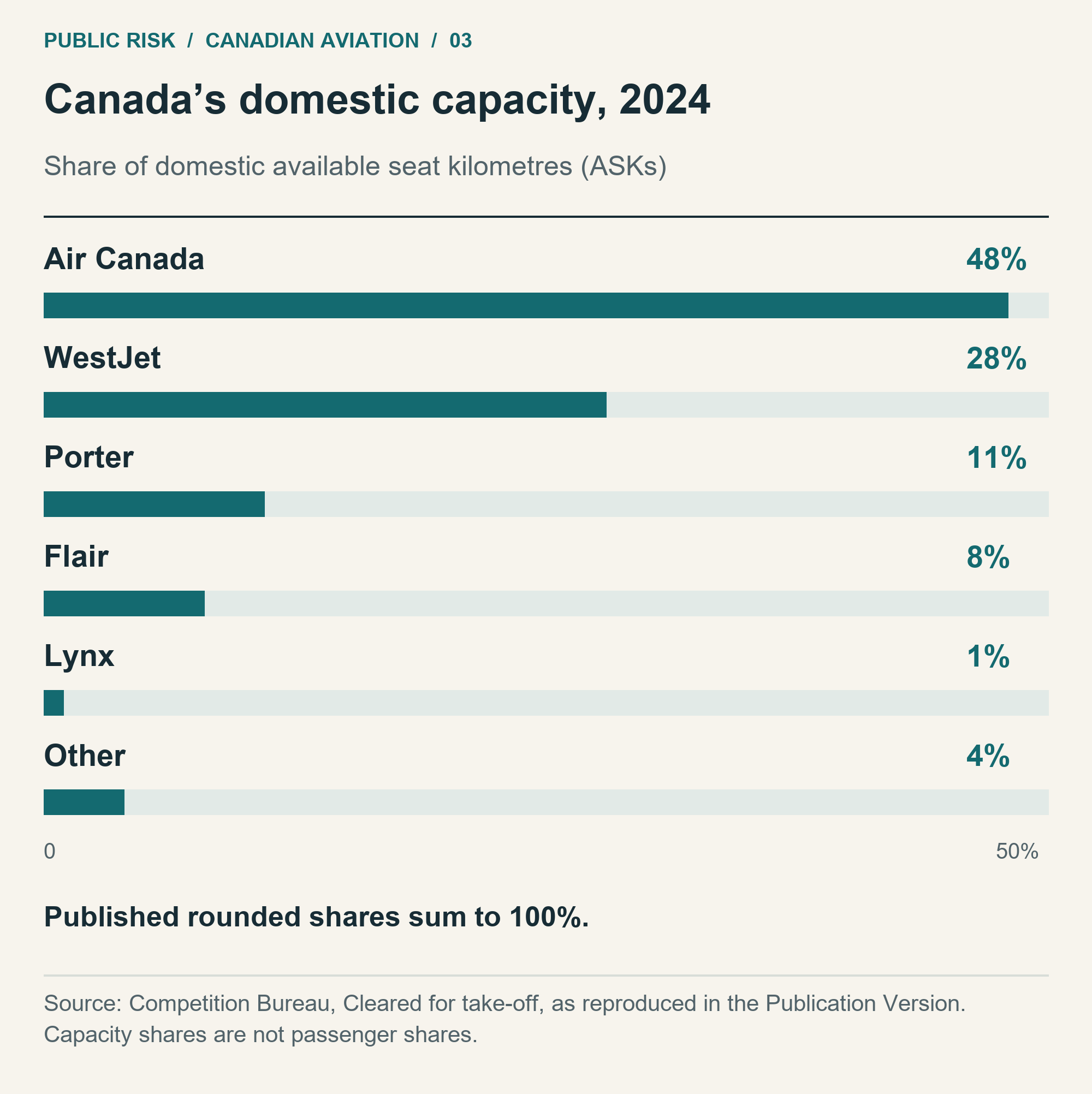
Competition Bureau data show that Porter’s share of domestic available seat kilometres rose from roughly 2% in 2019 to 11% in 2024. Flair rose from about 2% to 8%. In 2024, Air Canada held 48% and WestJet 28%, while smaller carriers accounted for the remaining share.
The Bureau describes domestic aviation as highly concentrated and competition from newer carriers as fragile. It also found a direct consumer effect at the route level: Air Canada, WestJet and Porter priced about 9% lower on average when they faced an additional competitor on a route.
That does not tell us what fares would have been without LASR. It does establish that additional airline competition has measurable pricing consequences.
To examine the structural sensitivity of the national market, we can run a simple HHI stress test using the Bureau’s complete published 2024 domestic-capacity shares: Air Canada 48%, WestJet 28%, Porter 11%, Flair 8%, Lynx 1% and Other 4%. These rounded shares sum to 100%.
The resulting approximate HHI is 3,290.
This is not the Competition Bureau’s official HHI and it is not a formal antitrust market definition. The Bureau itself performs route-level concentration analysis using passenger shares. Our calculation serves a narrower purpose: comparing the same national capacity structure against hypothetical exits.
Under proportional redistribution of an exiting carrier’s capacity among the remaining airlines:
Without Flair: HHI rises to approximately 3,811.
Without Porter: approximately 4,001.
Without Porter and Flair: approximately 4,733.
A second, deliberately more concentrated sensitivity scenario assigns 100% of the exiting carrier’s released capacity to Air Canada and WestJet, divided between them in proportion to their existing 48:28 capacity shares. Under that upper-stress assumption:
Without Flair: approximately 3,910.
Without Porter: approximately 4,128.
Without both: approximately 4,842.
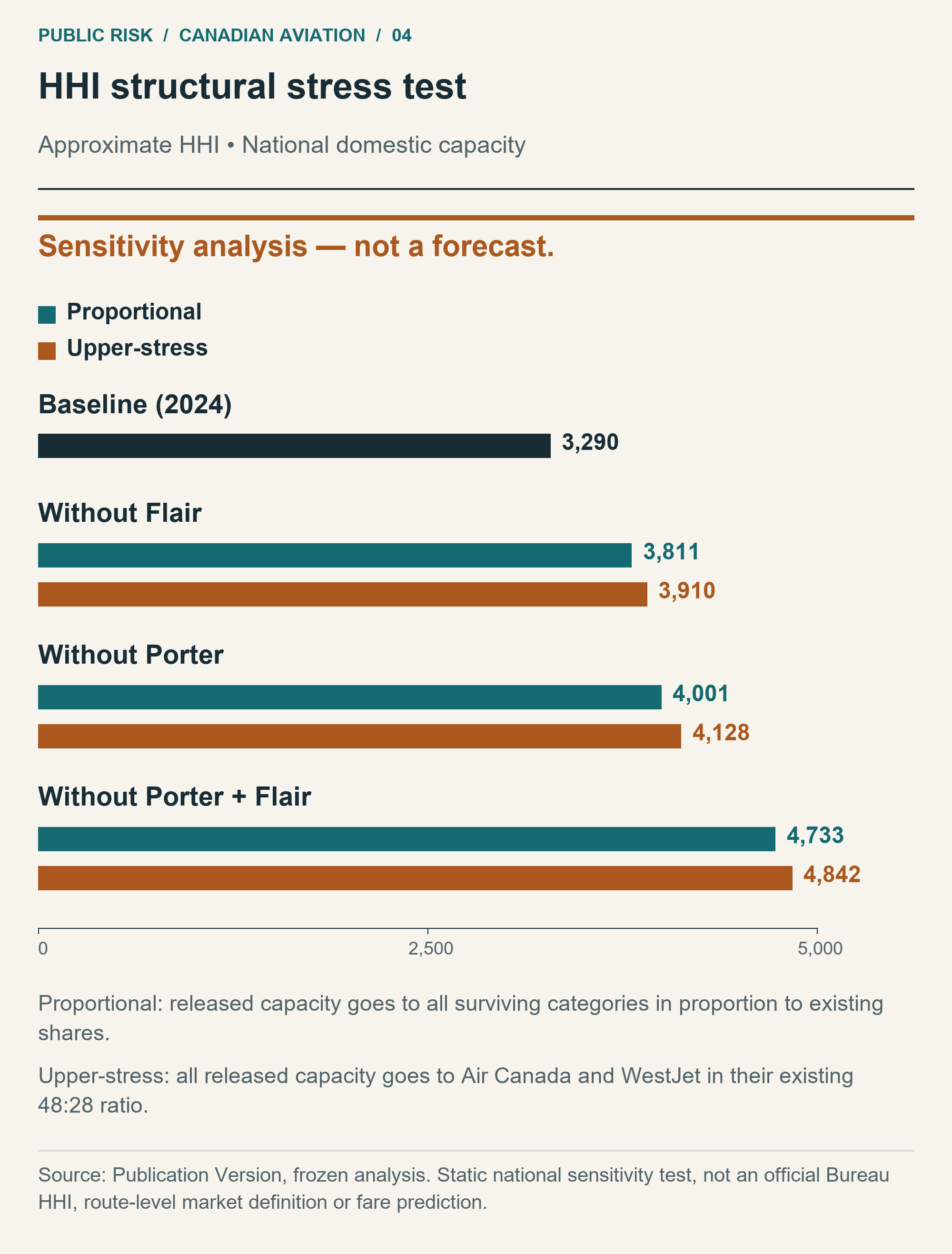
The upper-stress assumption is not a prediction. It deliberately tests the concentration effect if all released challenger capacity were absorbed by the two dominant incumbents.
What matters is that the broad result survives both assumptions. The magnitude changes. The direction does not.
Removing challengers from an already concentrated market makes the national capacity structure materially more concentrated.
There are important limits. Passengers buy tickets between cities, not in an abstract national market. A carrier with a modest national share may exert far more competitive pressure on specific routes. Capacity can also be replaced over time by surviving airlines or new entrants. A static HHI can therefore overstate long-run concentration if entry occurs quickly.
But replacement is neither automatic nor instantaneous. The Bureau’s own study documents how difficult it has been for new Canadian airlines to enter, survive and grow.
This gives LASR a plausible second function beyond liquidity support: insurance against a temporary external shock producing a durable increase in concentration.
WestJet’s objection — and the paradox
WestJet strongly opposed LASR, calling government loans market-distorting and arguing that airlines should compete on their own financial strength.
That objection identifies a genuine economic danger.
Competition is supposed to discipline firms. If a structurally weak company receives public financing simply because its disappearance would make a market more concentrated, competition policy becomes circular: a competitor must be preserved because competition requires competitors.
Taken far enough, that logic protects firms from the very market discipline competition is supposed to provide.
But WestJet is also an interested participant. With approximately 28% of domestic capacity in 2024, it is one of the two dominant incumbents that could potentially benefit if challengers weaken or exit.
That does not make WestJet’s argument wrong. It means its incentives belong in the analysis just as Ottawa’s do.
LASR therefore contains a real paradox.
If government refuses to intervene during an extraordinary external shock, a viable challenger can disappear and concentration can rise.
If government intervenes too readily, public credit can protect weak firms from risks their competitors must absorb privately.
The first mechanism can weaken competition through exit.
The second can weaken competition through subsidy.
The same loan can do either — depending on the borrower.
Bridge, rescue, or both?
That is why $376 million is a useful headline but a poor description of program risk.
A dollar of credit to a rapidly expanding challenger with continuing access to external asset finance is not economically identical to a dollar extended to a highly leveraged borrower that has already undergone government-supported restructuring. Neither is identical to lending to a private carrier whose financial condition cannot be independently observed.
A serious fiscal evaluation would therefore need to estimate expected loss borrower by borrower:
Expected taxpayer loss = probability of default × loss given default × exposure at default.
Interest and fees compensate the government for accepting that risk.
Without credible estimates of those components, neither side can establish the fiscal outcome from the principal alone.
Supporters cannot say: they are loans, therefore taxpayers are protected.
Critics cannot say: $376 million was approved, therefore taxpayers lost $376 million.
Both confuse exposure with outcome.
The evidence instead produces three provisional classifications.
Porter is the strongest bridge-finance case. Its visible pre-shock vulnerability was tied to aggressive expansion, while it had become a meaningful challenger in the domestic market. The missing financial statements prevent certainty.
Transat is the hybrid. Its operating recovery was real, but so was its pre-existing balance-sheet fragility. LASR absorbed a genuine fuel shock while also becoming part of a broader government-credit relationship that required another $250 million intervention only months later.
Flair remains the uncertainty case. Operations improved materially, but the public record is not sufficient to establish how much financial resilience had been rebuilt before the shock.
Those differences make a single ideological label misleading.
Calling the entire program a bailout obscures the structure of the loans and the differences among borrowers.
Calling it ordinary commercial lending obscures the government’s willingness to accept risks private lenders may not have accepted on comparable terms.
Calling it competition policy alone ignores the possibility that protecting weak competitors can itself distort competition.
LASR sits between all three.
What would prove it worked?
Not survival alone.
An airline can survive because it was fundamentally viable and successfully bridged a temporary shock. It can also survive because public financing postponed losses.
The better test requires time.
Did each borrower return to sustainable operations after the fuel shock normalized?
Did it repay LASR principal, interest and fees?
Did it require additional government support?
Did it continue providing meaningful competitive capacity?
And were taxpayers compensated for the risk they actually assumed?
Transat has already complicated that test because LASR was followed by another $250 million LEEFF facility. Porter and Flair remain open cases.
The experiment is still running.
LASR was neither obviously a giveaway nor demonstrably market-neutral emergency lending. It was a deliberate transfer of some airline credit risk onto the federal balance sheet during an extraordinary fuel shock.
For some borrowers, that transfer may also have protected competition by reducing the risk that temporary liquidity pressure would permanently remove challengers from an already concentrated market. For others, it may have supported vulnerabilities that existed before fuel prices surged.
That distinction is the case.
The question is not whether government should ever protect an airline. It is whether government can identify the point at which protecting an airline still protects competition — and the point at which it merely protects the airline.
Canada has approved $376 million of LASR credit to that experiment.
The final answer will not be found in the announcement that created LASR.
It will be found in who repays it.
Methodology note
This article distinguishes approved facilities, known draws and taxpayer losses. Its national HHI analysis uses the Competition Bureau’s complete rounded 2024 domestic available-seat-kilometre shares: Air Canada 48%, WestJet 28%, Porter 11%, Flair 8%, Lynx 1% and Other 4%, which sum to 100%. The HHI scenarios are static structural sensitivity tests, not predictions of airline failure, capacity redistribution, route-level competition or fares. The proportional scenario redistributes exiting capacity across all surviving categories in proportion to their existing shares. The upper-stress scenario assigns all released capacity to Air Canada and WestJet in proportion to their existing 48:28 shares. Financial classifications are based on publicly available information and are necessarily more tentative for privately held Porter and Flair.
Key sources
Department of Finance Canada — LASR launch and policy rationale
Canada Enterprise Emergency Funding Corporation — LASR terms and approved facilities
https://ceefc-cfuec.ca/lasr-overview/
https://ceefc-cfuec.ca/approved-loans/
Competition Bureau Canada — Cleared for take-off: Elevating airline competition
Transat — 2026 Q2 and Q3 results; LASR financing; 2025 LEEFF restructuring
https://www.transat.com/en-CA/corporate/investors
https://www.transat.com/en-CA/corporate/media/news-releases/124618
https://www.transat.com/en-CA/corporate/media/news-releases/124565
WestJet — response to LASR
Statistics Canada — civil aviation operating statistics and fuel data
https://www150.statcan.gc.ca/t1/tbl1/en/tv.action?pid=2310007901